Stand at the stone gates on Beachwood Drive on any given morning and you'll watch the same scene repeat itself: a rental car slows to a stop, someone leans out with a phone, and the Hollywood Sign gets photographed for the ten-thousandth time that week. Fifty feet up the block, the Beachwood Market is running its model train through the aisles for a kid whose parents are picking up Enzo's sourdough, and nobody inside the market looks up.
That gap between what the neighborhood looks like from the road and what it's actually doing is the story. Beachwood Canyon runs on two clocks. One belongs to the Hollywood Sign and moves at the speed of tourism, permits, and viral moments. The other belongs to the 500-acre Hollywoodland tract platted in the 1920s and moves at the speed of a family-run market, a monthly neighborhood association newsletter, and a Planning and Land Use committee that meets in a fire station annex. Almost nothing that makes it onto Yelp or Instagram is happening on the second clock, and understanding which one you're watching tells you what actually changes here and what doesn't.
Three Buildings, Not Four
The commercial core of Beachwood Canyon has consisted of the same handful of addresses for a century: a market, a cafe next door, and a real estate office built in 1923 that's still standing at the entrance to the tract. The Beachwood Market and Beachwood Cafe share a parking lot, share a deli case, and have been under the same family's ownership for generations. Outside Beachwood Canyon, a nearby diner did change hands, and it made news across the city.
The old 101 Coffee Shop, the diner that spent decades as a backdrop for films like "Swingers," closed permanently during the pandemic. Zack Hall, the founder of Clark Street Bread, took over the space on Franklin Avenue and reopened it as Clark Street Diner rather than folding it into his bakery brand. When LA Mag covered the takeover, Hall put it simply: he wasn't gutting the place, just planning to "freshen it up a little bit." He kept the booths, kept the original staff, kept the wraparound mirror over the bar.
Back in Beachwood Canyon, the village doesn't add storefronts. It occasionally swaps an owner behind the same four walls, and everyone treats the swap as a genuinely big deal because it so rarely happens.
The Village Built Its Own Immune System
The mismatch between a tiny commercial strip and a global photo backdrop doesn't resolve itself. Somebody has to manage it, and in Beachwood Canyon that job has fallen to the Beachwood Canyon Neighborhood Association for over a decade.
In 2015, the city converted most of the streets north of Franklin into preferential parking districts, restricting curbside spots to residents only. In April 2017, the city permanently closed the Beachwood Drive gate that had served as the main public access point to the Hollyridge Trail, after Sunset Ranch Hollywood Stables sued over tourist traffic cutting through its easement road. The gate closure and parking restrictions are documented on Wikipedia's Hollywood Sign page, and they're the reason every hiking guide to the sign now routes people to Brush Canyon Trail instead.
The same defensive work showed up again this year. In February 2026, actress Sydney Sweeney climbed on the Hollywood Sign itself during what TMZ reported was a legally shaky move. The neighborhood association's own read on it, posted to members, was precise: she may have had a city film permit to shoot in the area, but she didn't have permission to touch or climb the sign, and she hadn't cleared it with the Hollywood Chamber of Commerce either. That distinction between a location permit and a climbing permit is exactly the kind of granular boundary-keeping the neighborhood does constantly, mostly out of public view. You can read the association's running log of these issues at beachwoodcanyon.org.
None of this changes what the sign looks like in a photo. It changes what happens on the streets underneath it, which is the only part residents actually experience.
The Six Stairways Residents Actually Use
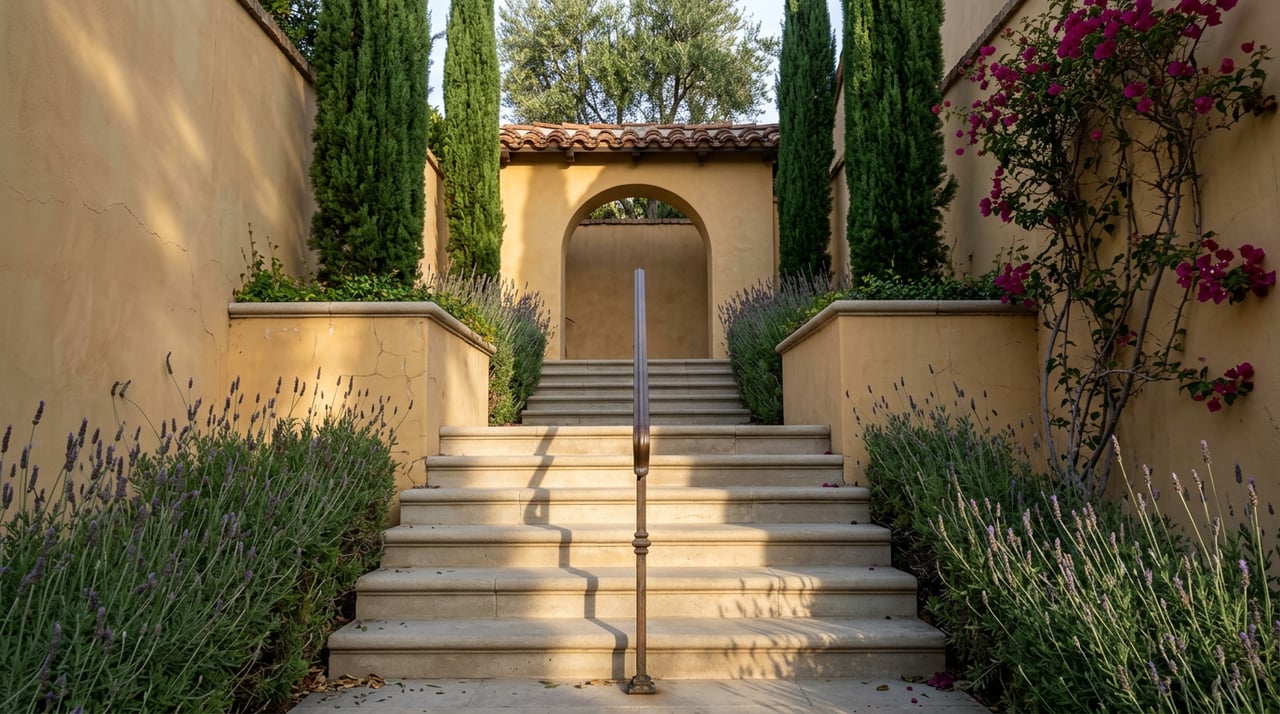
Long before Instagram, Hollywoodland's developers built granite stairways to connect the upper and lower canyon streets, since the terrain was too steep for a simple grid. Six sets remain, built by Italian masons using stone from the old Union Rock Quarry. In 1991 the city declared them Historic-Cultural Monument No. 535, and the official marker text is on file with the Historical Marker Database.
Tourists rarely find them. Residents use them as a workout loop that has nothing to do with reaching the sign. The actual walking geography of the neighborhood looks like this:
- The six granite stairways, starting near Foothill east of Cheremoya, connecting the lower village to the upper hillside streets
- Brush Canyon Trail, the fire road that replaced the closed Beachwood Drive gate as the sanctioned route toward Mount Lee, with a short detour to the old Union Rock Quarry, known locally as the Bat Cave for its use as a filming location in the 1966 Batman TV series
- The Hollyridge Trail proper, which continues past the sign toward Cahuenga Peak for residents who want the longer climb
A tourist sees one trailhead. A resident sees a stairway system built in 1923 that still functions exactly as designed, a rerouted trail that's been rerouted since 2017, and a quarry that used to double as a superhero's lair.
A Slower Clock Inside the Gates
The clearest example of the neighborhood's own pace sits behind a wall most people walk past without noticing. The Monastery of the Angels, a community of cloistered nuns, was founded in Beachwood Canyon in 1924 and spent decades supporting itself by selling pumpkin bread and peanut brittle through a small gift shop window.
By the time neighbors gathered on February 5, 2026, the cloistered community was gone and the conversation had shifted to who would occupy the building next. The Planning and Land Use Management Committee met that evening at the Fire Station 82 Annex on Bronson Avenue to discuss new tenants for the building, Homeboy Industries. According to the meeting notice circulated by the neighborhood association, the plans include no architectural changes to the structure and call for restoring the building's original windows.
A monastery that opened a century ago is becoming home to a different mission, decided over folding chairs in a fire station conference room, with a carpool request at the bottom of the email. That's the neighborhood's real clock. It has nothing to do with the sign, the market, or the tourists photographing both.
What Actually Fills the Calendar
If you're trying to feel out the rhythm of a year in Beachwood Canyon, the events that matter are the ones that never leave the neighborhood association's own newsletter. Every December, the association organizes the Howliday Pawrade, now in about its sixth year, where dogs wear light-up collars and residents walk them down to the Village for treats, cookies, and mulled wine. It's a parade with a fixed, small audience by design, ending at the same market and cafe that anchor everything else here.
That's the texture that outside coverage misses entirely. The sign draws visitor volume that keeps growing. The neighborhood's actual social calendar, its business continuity, and its zoning decisions move at a pace set by the people who live inside the gates, largely indifferent to how many strangers are photographing the same view from the street below.
If you spend enough time in this canyon, you start to notice which stories belong to which clock. The market's model train, the monastery's committee meeting, and the dog parade belong to the slow one. The diner's quiet handoff happened just beyond the village, a nearby change that drew attention without being part of its story. The permit disputes, the parking restrictions, and this year's sign-climbing controversy belong to the fast one, the one built entirely to manage the first.
Marc Robinson has spent years reading Los Angeles neighborhoods at exactly this level of detail, the kind that separates a postcard view from the place people actually live. If you're thinking about property anywhere in the Hollywood Hills and want a read on how a specific pocket actually functions day to day, Marc Robinson is glad to talk it through. Schedule a confidential consultation whenever you're ready.
This article is general information, not legal, tax or financial advice. Consult a qualified professional about your situation.